This repo's central marketing claim is "we fix bugs upstream won't." That's an
easy thing for a fork to say and an easy thing to get wrong, because the
natural way to back it up (describe the bug, describe the fix) is also the
natural way to misremember it, round it up, or quietly stop being true once
nobody's checking. demo/fork-fixes-data.ts is this project's answer: a
before/after showcase where every entry names a real commit, and the build
fails if the "before" render and the "after" render come out identical. That
page didn't arrive as a finished habit. It took four issues, closed over
about eleven days, to go from a single page to something a reader can
actually verify.
Building something real, not something plausible (#189)
#189 asked for a demo
page making the fork's case "before/after" instead of in prose, timed to the
~78 fixes about to ship in the first release. Its scope note is specific
about how: reuse the project's own render path against the pre-fix commit
and the current tree, rather than hand-drawing what "before" looked like.
That constraint shows up directly in fork-fixes.ts's own header comment
today:
Nothing here is hand-drawn — a "before" that stopped reproducing would show up as an identical pair, which the generator fails on rather than quietly publishing.
demo/fork-fixes-data.ts currently holds 28 entries (merged via
#211 and grown since).
Each one names a fixCommit, a PR number, and a minimal Mermaid source; the
generator renders it once against fixCommit^ and once against the working
tree, so 28 entries means 56 real renders checked on every build, not 28
screenshots taken once and committed.
Here is the page itself, as a reader lands on it — pnpm run fork-fixes
output, opened in a browser:
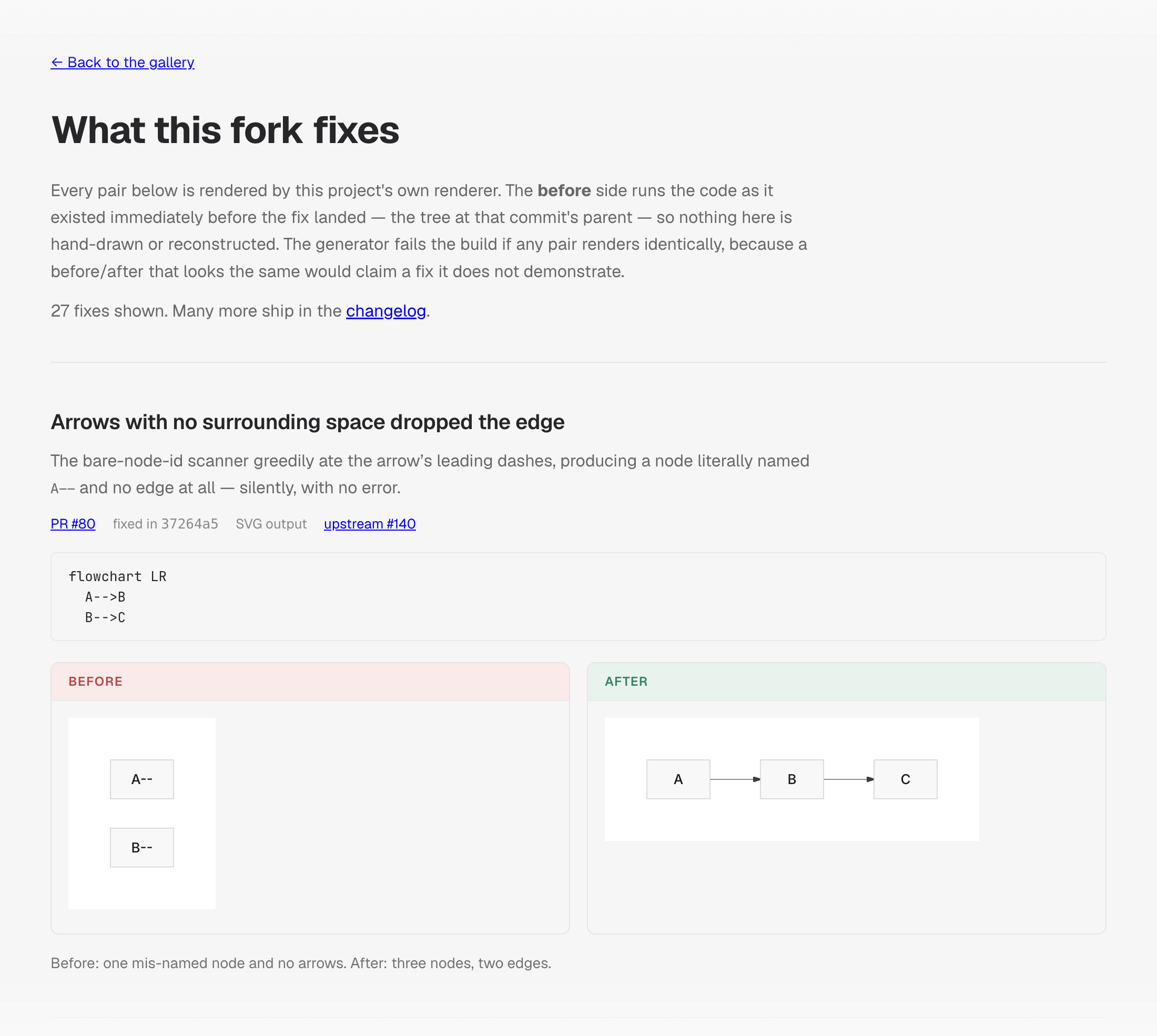
Everything a reader needs to check the claim is on the page: the exact
Mermaid source, which commit fixed it, which PR carried it, which upstream
issue it traces to, and both renders. The "before" panel isn't a description
of a parser bug — it's what the parser at 37264a5^ actually produced from
those three lines.
One entry is worth calling out on its own, because it shows the project
distrusting its own evidence a full week before that became a repo-wide rule.
The start-arrow-markers fix, a double-reversed SVG marker that pointed
bidirectional arrowheads the wrong way, rendered fine in Chrome and
degenerately in librsvg and Inkscape. A before/after screenshot pair taken in
a browser would have shown two identical pictures: a false negative, not
evidence the bug was gone. So that entry doesn't show a picture. It shows the
markup instead, the <marker> definition's points attribute before and
after, because that's where the real difference lives, and a rendering
that's forgiving of the bug can't be trusted to expose it.
Deciding it was worth surfacing (#257)
Once the page existed, it was still only reachable by clicking through the
demo site's hero buttons.
#257 argued that a
page this credible shouldn't be a build artifact nobody finds. It asked for
a prominent README link, per-fix social posts, and comments on the upstream
beautiful-mermaid issues each fix addresses, crediting the original
reporters.
PR #356 closed the part a code change can actually do: a badge at the top of the README next to the Live Demo badge, and a line in "Why This Fork Exists" pointing straight at the page:
This isn't just a claim — see what this fork fixes for an evidence-based before/after showcase: every bug listed there is rendered by the actual pre-fix and post-fix code, not described from memory.
The PR is explicit about what it didn't do: the social posts and the upstream credit comments needed accounts and repo access the change itself didn't have, so it left them as open follow-ups rather than claiming credit for the whole issue. That's a small thing, but it's the same discipline the page itself practices: say what's actually verified, not what would look better rounded up.
Keeping it from going stale (#295)
A showcase's evidentiary value only holds if it keeps growing with the fork. #295 named the risk directly: treating the page as a one-time backfill would let it quietly stop representing the current state of the fork, and proposed two options: a PR template checkbox, or a lint that nudges rather than blocks.
PR #371 took a
deliberately non-blocking route: a CONTRIBUTING.md section on when and how
to add an entry, a PR template checklist line, and a new
.github/workflows/fork-fixes-nudge.yml that posts a single advisory comment
on a bug-labeled PR that doesn't touch demo/fork-fixes-data.ts, without
ever failing the build. The PR's own reasoning for skipping a hard gate is
worth keeping: auto-detecting "this is a bug fix" from labels and "did it
change rendered output" from a diff are both heuristics that get it wrong in
both directions, and a gate built on either produces either false-positive
nagging or false-negative silence. A nudge gets the reminder in front of a
contributor, including one who's never read this repo's CLAUDE.md, without
pretending a heuristic is a guarantee.
Whether that habit actually stuck is a checkable claim, not an assertion, so
here's the check: demo/fork-fixes-data.ts's commit history after PR #371
merged on 2026-09-01 shows three more commits touching the file on
2026-09-05, adding entries for the #418 class-generics and edge-label fixes,
the #488/#489 class column-width fixes, and a class-label-detour-routing fix.
The habit outlived the PR that mandated it by four days before this post was
written, which is the only kind of evidence that "standing habit" means
anything more than a paragraph in CONTRIBUTING.md.
Closing the last gap: can a reader check it without leaving the page? (#402)
The first three issues made the page real, then worth finding, then self-sustaining. The fourth found a gap in a different direction: even a real screenshot is unverifiable if the reader can't see what produced it. #402 was filed against PR #387, whose "Visual verification" section showed before/after screenshots and said they rendered "the exact reproduction from the issue," but the mermaid source itself lived only in the linked issue, not the PR. A reviewer, or a reader six months later, would have to go find that issue and hope it still contained a matching repro.
PR #466 closed it in
one change to three files: this repo's CLAUDE.md, the
verify-ascii-terminal skill, and CONTRIBUTING.md, all updated to the same
rule. As CLAUDE.md states it today:
Whenever a PR or issue includes a "Visual verification" (or equivalent before/after) section for this category of change, paste the exact Mermaid source used to produce both renders inline, in a fenced
```mermaidcode block directly after that heading — before the before/after image table, not after it — rather than only linking to a sample index or a separate issue's reproduction.
That ordering, source first and pictures second, is the point. A PR or issue is supposed to be checkable from its own body, without chasing a link that might rot or a repro that might have been edited since.
The screenshot pipeline gets the same scrutiny
CLAUDE.md doesn't stop at requiring the source. The same section names a
second failure mode this repo had already shipped once: two of its own
tools, the Playwright visual-regression suite and scripts/visual-diff.ts,
render ASCII output through ascii-html.ts's HTML approximation of a
terminal, never a real one. PR #312,
"scroll wide ASCII terminal panels instead of overflowing the card," fixed a
real bug in that approximation's own chrome while the underlying
renderMermaidASCII renderer had been correct the whole time. That's proof
the mockup and the real thing can drift independently, in either direction.
PR #345, merged four
days before #402 was even filed, had already drawn the conclusion: a
verify-ascii-terminal skill that renders a sample through a real PTY
(asciinema piped through agg, headlessly, so no window ever opens) on
both the base branch and the change, before any screenshot is trusted enough
to attach to a PR. CLAUDE.md now states this as a hard requirement on the
attached image itself, not a correctness check that gets discarded once a
prettier browser screenshot is available: the visual-regression suite and
scripts/visual-diff.ts stay useful for iterating locally, but neither one
is allowed to supply the picture that ends up in a PR or issue body for an
ASCII-touching change.
It's the same discipline the fork-fixes page runs on itself, one level further down: #189 made sure the screenshot was real, and #402 made sure the source behind it was included, but neither one checks that the pipeline producing the picture is the one a real user actually hits. If it isn't, the "evidence" is evidence for a mockup, not for the product.
What four issues bought
Each of these closes a distinct way "before/after" can stop meaning anything. #189 makes the pair real: the build fails rather than publish a before that no longer reproduces. #257 decides a real pair sitting in a build artifact is worth surfacing, and says plainly what it didn't get to instead of rounding up. #295 keeps the second entry as certain as the first, against the ordinary pull of every backlog toward "we'll add it later." #402 makes each individual claim checkable from the PR or issue body alone, without a reader having to trust a link. None of it proves the fork fixes more bugs than it actually does. That's still down to whoever writes the entry. What it buys is narrower and more useful: a reader doesn't have to take "before/after" on faith. They can check it themselves, from what's already in front of them, against a render pipeline that matches what they'd actually run.