Adopting an abandoned library is a bet. You are trading the certainty of "someone else maintains this" for the uncertainty of "we do, now." The usual way people talk themselves into that bet is vibes: the code looks clean, the last commit wasn't that long ago, how bad could it be. We didn't want to find out the hard way six months in, so before doing anything else with this fork we spent one evening — 2026-08-25 — trying to break it on purpose.
The method was boring by design: pick both rendering backends this project
ships (SVG and ASCII), go through them diagram type by diagram type
(flowchart, sequence, class, ER, state), and for every place the output
looked wrong, file one issue with a minimal .mmd repro and the specific
line of code responsible. No fixing yet. Just cataloguing.
Eighteen issues in seventeen minutes
The filing timestamps tell the story better than a summary would.
#54 went in at
19:32:21 UTC. By 19:49:06, eighteen issues existed — #54
through #69, then
#73 and
#74 a few minutes
later once a nested-subgraph repro took longer to construct. Three of
those eighteen weren't rendering bugs at all — a missing require export
condition in package.json and two feature requests, filed in the same
sweep because they were also sitting right there. The other fifteen were
exactly what the method was built to produce: reproducible defects in how
the two renderers turn Mermaid source into pixels or characters.
That's fifteen, not the round "twenty" this series' outline reached for. Real audits don't land on tidy numbers, and getting the count right matters more here than getting a rounder one — the whole point of this post is that the list is evidence, and evidence you've inflated stops being evidence.
Ten of those fifteen are worth walking through, because they're not the same bug in a trenchcoat. They span both renderers and touch parsing, layout, and paint — which is itself informative: a fork with one deep, narrow problem is a different kind of risk than a fork with a dozen shallow ones scattered across every subsystem.
What was actually broken
Four of the ten below carry a before/after pair. Every one of those images
is real output, not an illustration: each "before" comes from checking out
the tree at the fix commit's parent (git archive <fixCommit>^ src) and
running the same Mermaid source through it that the "after" gets run
through on current main. The SVG pairs are the renderer's own
renderMermaidSVG output, embedded as SVG. The ASCII pairs are real
terminal captures — asciinema recording an actual PTY, rasterized by
agg — not a browser's HTML approximation of a terminal, which is a
distinction this project has already been bitten by. The exact source for
each pair is printed above it, so you can re-run any of them yourself.
SVG output lied about direction. #54
found that every marker-start arrowhead was double-reversed, so a
bidirectional edge (<-->) rendered with only its end arrowhead, and a
backward edge (<-.-) rendered with no arrowhead at all — just a bare
line pointing nowhere in particular. The marker's polygon was already
mirrored for orient="auto-start-reverse", and the reverse orientation
mirrored it again. Two negatives that should have cancelled out didn't,
because they were applied in two different places (src/renderer.ts, and
mirrored again in the class and sequence renderers) that had drifted out
of sync with each other.
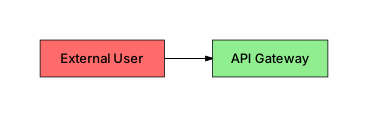
SVG output was unreadable in the theme half its users would pick.
#55 found that a
node with a custom fill from classDef or style always got its label
text painted in the theme's foreground color — meaning a light pastel fill
under a dark theme (fg: '#FAFAFA') rendered white text on a light-red
background. The renderer knew the node's custom color. It just never
asked whether that color needed light or dark text on top of it.
graph LR
  classDef external fill:#FF6B6B
  classDef api fill:#90EE90
  A[External User]
  B[API Gateway]
  A --> B
  class A external
  class B api
Before (566b195^) |
After (current main) |
|---|---|
 |
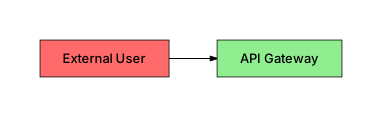 |
Before/after renderMermaidSVG(source, { bg: '#18181B', fg: '#FAFAFA' }).
Same fills, same labels — the only thing that changes is the text color,
which the fix now derives from the fill's own luminance instead of the
ambient theme foreground.
SVG output silently dropped styling hooks. #56
found that :::className shorthand correctly resolved classDef fill and
stroke onto a node, but never wrote the class name itself onto the
rendered <class> attribute — so a page embedding the SVG inline with its
own CSS had no way to select that node. mermaid.js emits the class name.
This fork's shorthand path quietly didn't.
The ER parser sorted away information it needed.
#59 found that
parseCardinality() normalized a cardinality token by sorting its
characters alphabetically before comparing it against a fixed set —
so }o (zero-or-more) and its mirror both collapsed to the same sorted
string as something else, and the wrong cardinality symbol rendered on the
wrong side of the relationship. The same issue covered entity aliases and
a direction directive that parsed fine and then did nothing, because
nothing downstream read the field it was parsed into.
A trailing semicolon made styling vanish.
#60 found that
class A,B className; — semicolon and all, which is legal Mermaid — never
matched the regex src/parser.ts used to detect a class assignment,
because that regex was anchored with $ at the very end of the line. The
statement fell through to being treated as a stray node instead, so not
only did the styling never apply, the literal text class could show up
as a rendered label.
Two different tokenization bugs shared one flowchart parser.
#61 found that
A-->B with no surrounding spaces produced one bogus node (A--) and
zero edges — the arrow got consumed into the node id — while A --> B
and A -->B both parsed correctly. The same issue found that brackets
inside a quoted label corrupted the label text. Neither bug depended on
the other; they'd just never been noticed because most hand-written
Mermaid puts spaces around arrows.
flowchart LR
  A-->B
  B-->C
Before (37264a5^) |
After (current main) |
|---|---|
 |
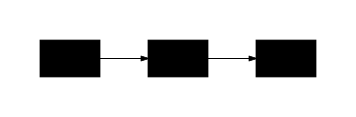 |
Two boxes named after the arrow that got eaten, and zero edges — from a three-node, two-edge diagram. No error, no warning; the render just quietly disagreed with the source.
The ASCII layout engine crashed outright.
#64 found that
src/ascii/grid.ts and its pathfinding and edge-bundling helpers threw a
hard RangeError (internally, a Map exceeding its maximum size) on
graphs with dense fan-in — many edges converging on one node. This is the
ASCII renderer's original custom routing code, not the ELK.js-backed
layout the SVG path had already moved to, so bugs here didn't get the
benefit of an off-the-shelf layout library's own test suite.
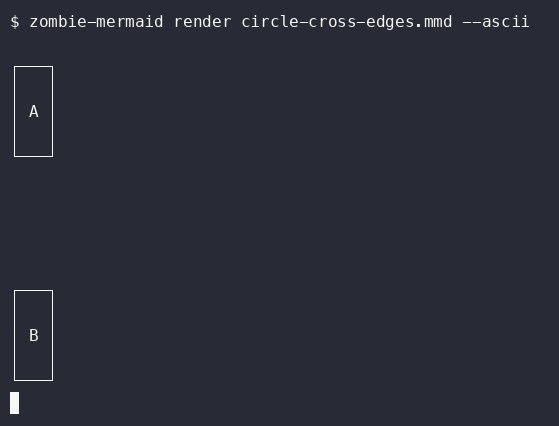
Two ASCII edge styles didn't render their own target node.
#65 found that
--o and --x edges — valid, documented Mermaid edge terminators —
rendered only the source box. A --o B printed A and silently dropped
B and the edge connecting them, no error, nothing in the output to
suggest anything was missing. Every other edge variant (-->, ---,
==>, -.-> , labeled edges) rendered both ends correctly.
flowchart LR
  A --o B
  B --x C
Before (77b5e3d^) |
After (current main) |
|---|---|
 |
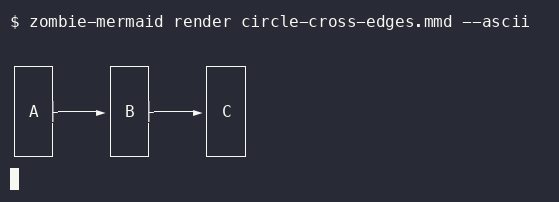 |
Real PTY captures, reused as-is from the pair fork-fixes.html already
publishes for this fix. Two edges and one whole node went missing; what
survived was laid out as if the source had only ever named two unrelated
boxes.
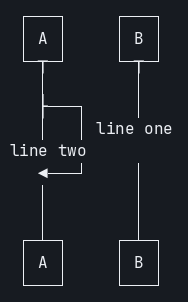
A self-arrow corrupted the whole canvas.
#68 found that a
sequence diagram self-arrow (A->>A: ...) with a <br/> in its label
didn't just render badly — it corrupted unrelated parts of the ASCII
canvas, and self-arrows generally could render outside their enclosing
alt/loop/opt block instead of inside it.
sequenceDiagram
  participant A
  participant B
  A->>A: line one<br/>line two
Before (d35d921^) |
After (current main) |
|---|---|
 |
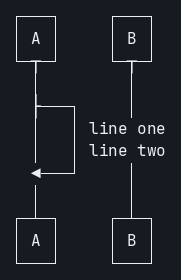 |
Real PTY captures. line two lands at column zero because the self-arrow
label was written character-by-character at a single y-coordinate with no
<br/> handling — so the newline inside it displaces everything to its
right, including B's lifeline, which has nothing to do with the message.
Nested subgraphs ignored their own direction.
#73 found that
direction directives on a subgraph nested inside another subgraph were
never honored, and edges crossing that boundary either failed to route
cleanly or stair-stepped through gaps too tight to hold them. The shared
ELK-based layout code (src/layout-engine/to-elk.ts) used
hierarchyHandling: 'SEPARATE' to let subgraphs override direction — the
exact mechanism that, read closely, was already known to produce
cross-boundary routing failures.
Two speeds of fixing, and why that split is itself informative
Of these ten, four were fixed the same evening they were filed — the arrowhead reversal, the dark-mode label contrast, the missing class attribute, and the trailing-semicolon parser bug, all closed within about four hours of being opened. Those four had something in common: each was a small, local, single-file fix once the actual defect was identified.
The other six — the ER parser bugs, the no-space-arrow tokenization bug,
the ASCII fan-in crash, the --o/--x dropped-node bug, the self-arrow
canvas corruption, and the nested-subgraph routing bug — landed the next
day, all but one by mid-afternoon. These touched shared parsing or layout
code with more surface area to get right, and in at least two cases
(the fan-in crash and the dropped-node bug) the fix commits carry test
coverage for edge cases the original bug report didn't even mention,
because fixing them properly meant understanding the whole routing path,
not just patching the one repro.
That split — same-evening for isolated defects, next-day for anything touching shared layout or parsing code — is a more honest signal than either "we fixed it fast" or "we fixed it thoroughly" would be on its own. Both things were true, for different bugs, for legible reasons.
The list is the pitch
None of this is an argument by adjective. It's not "this fork is well
maintained" or "we care about quality." It's ten dated, numbered,
independently reproducible defects, each with a file and line number, each
closed by a commit that a skeptical reader can go read right now — and
four of them shown above in the renderer's own output on both sides of
that commit. That's
what de-risking a bet on an abandoned library actually looks like in
practice: not a promise, a list. If the list is short and vague, the fork
probably isn't being tested hard. If it's this specific — arrowhead
polygons, cardinality-sorting collisions, Map size limits — it means
someone went looking with the assumption that something was broken, and
found out exactly what.
We'd go back to this well later. A handful of these same fixes — the
arrowhead reversal, the no-space-arrow bug, the ER cardinality and alias
bugs, the ASCII fan-in crash, the dropped-node bug, the nested-subgraph
routing bug — eventually got a second life as before/after entries in
fork-fixes.html, a page that renders each "before" from the actual
renderer as it existed immediately before its fix, not a description of it
from memory. A later post in this series goes deep on that page and why
"nothing described from memory" became a hard rule for this project's own
evidence. For this post, the numbered list from one evening in August is
the evidence on its own.